Glucose Can Be Used to Make Fatty Acids.
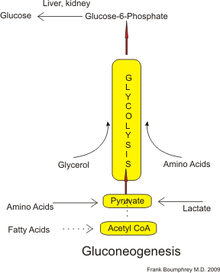
Simplified gluconeogenesis pathway (every bit occurs in humans). Acetyl-CoA derived from fatty acids (dotted lines) may be converted to pyruvate to a small extent under weather condition of fasting.
Gluconeogenesis (GNG) is a metabolic pathway that results in the generation of glucose from certain not-carbohydrate carbon substrates. It is a ubiquitous process, present in plants, animals, fungi, bacteria, and other microorganisms.[i] In vertebrates, gluconeogenesis occurs mainly in the liver and, to a lesser extent, in the cortex of the kidneys. It is one of two primary mechanisms – the other being degradation of glycogen (glycogenolysis) – used by humans and many other animals to maintain blood sugar levels, avoiding low levels (hypoglycemia).[2] In ruminants, because dietary carbohydrates tend to be metabolized by rumen organisms, gluconeogenesis occurs regardless of fasting, depression-sugar diets, exercise, etc.[3] In many other animals, the procedure occurs during periods of fasting, starvation, low-carbohydrate diets, or intense exercise.
In humans, substrates for gluconeogenesis may come from whatever non-sugar sources that can be converted to pyruvate or intermediates of glycolysis (encounter figure). For the breakup of proteins, these substrates include glucogenic amino acids (although not ketogenic amino acids); from breakdown of lipids (such every bit triglycerides), they include glycerol, odd-chain fat acids (although not even-chain fatty acids, see below); and from other parts of metabolism they include lactate from the Cori bicycle. Under weather of prolonged fasting, acetone derived from ketone bodies tin can besides serve as a substrate, providing a pathway from fatty acids to glucose.[4] Although nearly gluconeogenesis occurs in the liver, the relative contribution of gluconeogenesis by the kidney is increased in diabetes and prolonged fasting.[five]
The gluconeogenesis pathway is highly endergonic until it is coupled to the hydrolysis of ATP or GTP, effectively making the process exergonic. For example, the pathway leading from pyruvate to glucose-six-phosphate requires 4 molecules of ATP and 2 molecules of GTP to proceed spontaneously. These ATPs are supplied from fat acid catabolism via beta oxidation.[half dozen]
Precursors [edit]
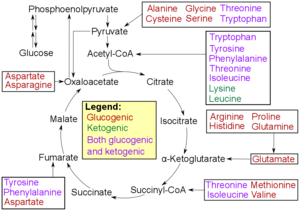
In humans the main gluconeogenic precursors are lactate, glycerol (which is a function of the triglyceride molecule), alanine and glutamine. Altogether, they account for over 90% of the overall gluconeogenesis.[8] Other glucogenic amino acids and all citric acid cycle intermediates (through conversion to oxaloacetate) tin can also function every bit substrates for gluconeogenesis.[9] By and large, human consumption of gluconeogenic substrates in food does non result in increased gluconeogenesis.[x]
In ruminants, propionate is the main gluconeogenic substrate.[iii] [xi] In nonruminants, including homo beings, propionate arises from the β-oxidation of odd-chain and branched-concatenation fatty acids is a (relatively minor) substrate for gluconeogenesis.[12] [13]
Lactate is transported back to the liver where it is converted into pyruvate by the Cori cycle using the enzyme lactate dehydrogenase. Pyruvate, the get-go designated substrate of the gluconeogenic pathway, can then exist used to generate glucose.[nine] Transamination or deamination of amino acids facilitates inbound of their carbon skeleton into the bicycle directly (as pyruvate or oxaloacetate), or indirectly via the citric acid cycle. The contribution of Cori cycle lactate to overall glucose production increases with fasting elapsing.[xiv] Specifically, afterwards 12, 20, and 40 hours of fasting by human being volunteers, the contribution of Cori cycle lactate to gluconeogenesis was 41%, 71%, and 92%, respectively.[14]
Whether even-chain fatty acids can exist converted into glucose in animals has been a longstanding question in biochemistry.[xv] Odd-concatenation fatty acids can be oxidized to yield acetyl-CoA and propionyl-CoA, the latter serving as a precursor to succinyl-CoA, which can be converted to pyruvate and enter into gluconeogenesis. In contrast, even-chain fat acids are oxidized to yield only acetyl-CoA, whose entry into gluconeogenesis requires the presence of a glyoxylate cycle (too known as glyoxylate shunt) to produce 4-carbon dicarboxylic acrid precursors.[9] The glyoxylate shunt comprises two enzymes, malate synthase and isocitrate lyase, and is present in fungi, plants, and bacteria. Despite some reports of glyoxylate shunt enzymatic activities detected in animal tissues, genes encoding both enzymatic functions take only been found in nematodes, in which they exist equally a single bi-functional enzyme.[xvi] [17] Genes coding for malate synthase alone (but non isocitrate lyase) have been identified in other animals including arthropods, echinoderms, and even some vertebrates. Mammals found to possess the malate synthase gene include monotremes (platypus) and marsupials (opossum), but not placental mammals.[17]
The existence of the glyoxylate wheel in humans has not been established, and it is widely held that fatty acids cannot be converted to glucose in humans directly. Carbon-14 has been shown to end up in glucose when it is supplied in fatty acids,[xviii] but this can be expected from the incorporation of labelled atoms derived from acetyl-CoA into citric acid cycle intermediates which are interchangeable with those derived from other physiological sources, such as glucogenic amino acids.[15] In the absence of other glucogenic sources, the 2-carbon acetyl-CoA derived from the oxidation of fatty acids cannot produce a net yield of glucose via the citric acrid bicycle, since an equivalent two carbon atoms are released as carbon dioxide during the cycle. During ketosis, however, acetyl-CoA from fatty acids yields ketone bodies, including acetone, and upward to ~threescore% of acetone may be oxidized in the liver to the pyruvate precursors acetol and methylglyoxal.[xix] [4] Thus ketone bodies derived from fatty acids could business relationship for up to 11% of gluconeogenesis during starvation. Catabolism of fatty acids also produces energy in the form of ATP that is necessary for the gluconeogenesis pathway.
Location [edit]
In mammals, gluconeogenesis has been believed to be restricted to the liver,[20] the kidney,[20] the intestine,[21] and muscle,[22] but recent evidence indicates gluconeogenesis occurring in astrocytes of the brain.[23] These organs use somewhat different gluconeogenic precursors. The liver preferentially uses lactate, glycerol, and glucogenic amino acids (particularly alanine) while the kidney preferentially uses lactate, glutamine and glycerol.[24] [viii] Lactate from the Cori cycle is quantitatively the largest source of substrate for gluconeogenesis, especially for the kidney.[8] The liver uses both glycogenolysis and gluconeogenesis to produce glucose, whereas the kidney only uses gluconeogenesis.[viii] Subsequently a meal, the liver shifts to glycogen synthesis, whereas the kidney increases gluconeogenesis.[ten] The intestine uses mostly glutamine and glycerol.[21]
Propionate is the principal substrate for gluconeogenesis in the ruminant liver, and the ruminant liver may make increased use of gluconeogenic amino acids (due east.g., alanine) when glucose demand is increased.[25] The capacity of liver cells to apply lactate for gluconeogenesis declines from the preruminant phase to the ruminant stage in calves and lambs.[26] In sheep kidney tissue, very high rates of gluconeogenesis from propionate have been observed.[26]
In all species, the formation of oxaloacetate from pyruvate and TCA cycle intermediates is restricted to the mitochondrion, and the enzymes that convert Phosphoenolpyruvic acrid (PEP) to glucose-6-phosphate are plant in the cytosol.[27] The location of the enzyme that links these ii parts of gluconeogenesis by converting oxaloacetate to PEP – PEP carboxykinase (PEPCK) – is variable by species: it tin be found entirely within the mitochondria, entirely within the cytosol, or dispersed evenly between the two, equally it is in humans.[27] Transport of PEP across the mitochondrial membrane is accomplished past dedicated transport proteins; however no such proteins be for oxaloacetate.[27] Therefore, in species that lack intra-mitochondrial PEPCK, oxaloacetate must be converted into malate or aspartate, exported from the mitochondrion, and converted back into oxaloacetate in lodge to allow gluconeogenesis to proceed.[27]

Gluconeogenesis pathway with key molecules and enzymes. Many steps are the opposite of those establish in the glycolysis.
Pathway [edit]
Gluconeogenesis is a pathway consisting of a series of eleven enzyme-catalyzed reactions. The pathway will begin in either the liver or kidney, in the mitochondria or cytoplasm of those cells, this being dependent on the substrate being used. Many of the reactions are the reverse of steps found in glycolysis.
- Gluconeogenesis begins in the mitochondria with the germination of oxaloacetate by the carboxylation of pyruvate. This reaction likewise requires one molecule of ATP, and is catalyzed by pyruvate carboxylase. This enzyme is stimulated by loftier levels of acetyl-CoA (produced in β-oxidation in the liver) and inhibited past high levels of ADP and glucose.
- Oxaloacetate is reduced to malate using NADH, a step required for its transportation out of the mitochondria.
- Malate is oxidized to oxaloacetate using NAD+ in the cytosol, where the remaining steps of gluconeogenesis have place.
- Oxaloacetate is decarboxylated then phosphorylated to form phosphoenolpyruvate using the enzyme PEPCK. A molecule of GTP is hydrolyzed to GDP during this reaction.
- The side by side steps in the reaction are the same as reversed glycolysis. However, fructose 1,6-bisphosphatase converts fructose 1,6-bisphosphate to fructose half-dozen-phosphate, using one water molecule and releasing one phosphate (in glycolysis, phosphofructokinase i converts F6P and ATP to F1,6BP and ADP). This is also the rate-limiting stride of gluconeogenesis.
- Glucose-half-dozen-phosphate is formed from fructose half-dozen-phosphate past phosphoglucoisomerase (the reverse of step 2 in glycolysis). Glucose-six-phosphate can be used in other metabolic pathways or dephosphorylated to free glucose. Whereas free glucose can hands diffuse in and out of the cell, the phosphorylated form (glucose-6-phosphate) is locked in the cell, a machinery by which intracellular glucose levels are controlled by cells.
- The final gluconeogenesis, the formation of glucose, occurs in the lumen of the endoplasmic reticulum, where glucose-6-phosphate is hydrolyzed past glucose-six-phosphatase to produce glucose and release an inorganic phosphate. Like 2 steps prior, this step is non a simple reversal of glycolysis, in which hexokinase catalyzes the conversion of glucose and ATP into G6P and ADP. Glucose is shuttled into the cytoplasm past glucose transporters located in the endoplasmic reticulum's membrane.
| Metabolism of common monosaccharides, including glycolysis, gluconeogenesis, glycogenesis and glycogenolysis |
|---|
| |

Regulation [edit]
While nearly steps in gluconeogenesis are the reverse of those establish in glycolysis, 3 regulated and strongly endergonic reactions are replaced with more kinetically favorable reactions. Hexokinase/glucokinase, phosphofructokinase, and pyruvate kinase enzymes of glycolysis are replaced with glucose-6-phosphatase, fructose-one,half-dozen-bisphosphatase, and PEP carboxykinase/pyruvate carboxylase. These enzymes are typically regulated by similar molecules, but with opposite results. For case, acetyl CoA and citrate actuate gluconeogenesis enzymes (pyruvate carboxylase and fructose-1,vi-bisphosphatase, respectively), while at the same time inhibiting the glycolytic enzyme pyruvate kinase. This organization of reciprocal control allow glycolysis and gluconeogenesis to inhibit each other and prevents a futile cycle of synthesizing glucose to just break it downwardly. Pyruvate kinase can be also bypassed by 86 pathways[28] non related to gluconeogenesis, for the purpose of forming pyruvate and subsequently lactate; some of these pathways use carbon atoms originated from glucose.
The majority of the enzymes responsible for gluconeogenesis are found in the cytosol; the exceptions are mitochondrial pyruvate carboxylase and, in animals, phosphoenolpyruvate carboxykinase. The latter exists as an isozyme located in both the mitochondrion and the cytosol.[29] The rate of gluconeogenesis is ultimately controlled by the activeness of a key enzyme, fructose-1,6-bisphosphatase, which is also regulated through point transduction by army camp and its phosphorylation.
Global command of gluconeogenesis is mediated past glucagon (released when blood glucose is low); it triggers phosphorylation of enzymes and regulatory proteins by Protein Kinase A (a cyclic AMP regulated kinase) resulting in inhibition of glycolysis and stimulation of gluconeogenesis. Insulin counteracts glucagon by inhibiting gluconeogenesis. Type 2 diabetes is marked past excess glucagon and insulin resistance from the trunk.[30] Insulin can no longer inhibit the cistron expression of enzymes such as PEPCK which leads to increased levels of hyperglycemia in the body.[31] The anti-diabetic drug metformin reduces blood glucose primarily through inhibition of gluconeogenesis, overcoming the failure of insulin to inhibit gluconeogenesis due to insulin resistance.[32]
Studies have shown that the absenteeism of hepatic glucose product has no major consequence on the control of fasting plasma glucose concentration. Compensatory consecration of gluconeogenesis occurs in the kidneys and intestine, driven by glucagon, glucocorticoids, and acidosis.[33]
Insulin resistance [edit]
In the liver, the Flim-flam protein FOXO6 unremarkably promotes gluconeogenesis in the fasted country, but insulin blocks FOXO6 upon feeding.[34] In a condition of insulin resistance, insulin fails to block FOXO6 resulting in connected gluconeogenesis even upon feeding, resulting in high blood glucose (hyperglycemia).[34]
Insulin resistance is a common characteristic of metabolic syndrome and type two diabetes. For this reason gluconeogenesis is a target of therapy for type 2 diabetes, such as the antidiabetic drug metformin, which inhibits gluconeogenic glucose formation, and stimulates glucose uptake past cells.[35]
Run into also [edit]
- Bioenergetics
References [edit]
- ^ Nelson DL, Cox MM (2000). Lehninger Principles of Biochemistry. Usa: Worth Publishers. p. 724. ISBN978-one-57259-153-0.
- ^ Silva P. "The Chemical Logic Behind Gluconeogenesis". Archived from the original on August 26, 2009. Retrieved September 8, 2009.
- ^ a b Beitz DC (2004). "Sugar metabolism.". In Reese WO (ed.). Dukes' Physiology of Domestic Animals (12th ed.). Cornell Univ. Press. pp. 501–15. ISBN978-0801442384.
- ^ a b Kaleta C, de Figueiredo LF, Werner S, Guthke R, Ristow M, Schuster S (July 2011). "In silico evidence for gluconeogenesis from fatty acids in humans". PLOS Computational Biological science. seven (7): e1002116. Bibcode:2011PLSCB...7E2116K. doi:10.1371/journal.pcbi.1002116. PMC3140964. PMID 21814506.
- ^ Swe MT, Pongchaidecha A, Chatsudthipong V, Chattipakorn Northward, Lungkaphin A (June 2019). "Molecular signaling mechanisms of renal gluconeogenesis in nondiabetic and diabetic weather". Journal of Cellular Physiology. 234 (half-dozen): 8134–8151. doi:10.1002/jcp.27598. PMID 30370538.
- ^ Rodwell V (2015). Harper's illustrated Biochemistry, 30th edition. USA: McGraw Colina. p. 193. ISBN978-0-07-182537-five.
- ^ Ferrier DR, Champe PC, Harvey RA (one August 2004). "20. Amino Acid Degradation and Synthesis". Biochemistry (Lippincott'due south Illustrated Reviews). Hagerstwon, MD: Lippincott Williams & Wilkins. ISBN978-0-7817-2265-0.
- ^ a b c d Gerich JE, Meyer C, Woerle HJ, Stumvoll One thousand (February 2001). "Renal gluconeogenesis: its importance in homo glucose homeostasis". Diabetes Care. 24 (2): 382–91. doi:10.2337/diacare.24.2.382. PMID 11213896.
- ^ a b c Garrett RH, Grisham CM (2002). Principles of Biochemistry with a Homo Focus. United states: Brooks/Cole, Thomson Learning. pp. 578, 585. ISBN978-0-03-097369-seven.
- ^ a b Nuttall FQ, Ngo A, Gannon MC (September 2008). "Regulation of hepatic glucose production and the role of gluconeogenesis in humans: is the charge per unit of gluconeogenesis abiding?". Diabetes/Metabolism Research and Reviews. 24 (half dozen): 438–58. doi:10.1002/dmrr.863. PMID 18561209. S2CID 24330397.
- ^ Van Soest PJ (1994). Nutritional Ecology of the Ruminant (2nd ed.). Cornell Univ. Press. ISBN978-1501732355.
- ^ Rodwell VW, Bender DA, Botham KM, Kennelly PJ, Weil PA (2018). Harper'southward Illustrated Biochemistry (31st ed.). McGraw-Hill Publishing Company.
- ^ Baynes J, Dominiczak Thou (2014). Medical Biochemistry (4th ed.). Elsevier.
- ^ a b Katz J, Tayek JA (September 1998). "Gluconeogenesis and the Cori cycle in 12-, 20-, and 40-h-fasted humans". The American Journal of Physiology. 275 (three): E537–42. doi:ten.1152/ajpendo.1998.275.3.E537. PMID 9725823.
- ^ a b de Figueiredo LF, Schuster Due south, Kaleta C, Savage DA (January 2009). "Can sugars exist produced from fatty acids? A exam case for pathway analysis tools". Bioinformatics. 25 (i): 152–8. doi:ten.1093/bioinformatics/btn621. PMID 19117076.
- ^ Liu F, Thatcher JD, Barral JM, Epstein HF (June 1995). "Bifunctional glyoxylate bicycle poly peptide of Caenorhabditis elegans: a developmentally regulated protein of intestine and muscle". Developmental Biology. 169 (2): 399–414. doi:10.1006/dbio.1995.1156. PMID 7781887.
- ^ a b Kondrashov FA, Koonin EV, Morgunov IG, Finogenova TV, Kondrashova MN (October 2006). "Evolution of glyoxylate cycle enzymes in Metazoa: evidence of multiple horizontal transfer events and pseudogene germination". Biology Directly. 1: 31. doi:10.1186/1745-6150-ane-31. PMC1630690. PMID 17059607.
- ^ Weinman EO, Strisower EH, Chaikoff IL (April 1957). "Conversion of fatty acids to carbohydrate; application of isotopes to this trouble and role of the Krebs cycle equally a constructed pathway". Physiological Reviews. 37 (2): 252–72. doi:10.1152/physrev.1957.37.2.252. PMID 13441426.
- ^ Reichard GA, Haff Ac, Skutches CL, Paul P, Holroyde CP, Owen OE (Apr 1979). "Plasma acetone metabolism in the fasting man". The Journal of Clinical Investigation. 63 (4): 619–26. doi:10.1172/JCI109344. PMC371996. PMID 438326.
- ^ a b Widmaier E (2006). Vander's Man Physiology . McGraw Hill. p. 96. ISBN978-0-07-282741-5.
- ^ a b Mithieux Thou, Rajas F, Gautier-Stein A (October 2004). "A novel function for glucose half dozen-phosphatase in the small-scale intestine in the control of glucose homeostasis". The Journal of Biological Chemistry. 279 (43): 44231–4. doi:10.1074/jbc.R400011200. PMID 15302872.
- ^ Chen, Jinyu (February 1, 2015). "Gain of Glucose-Contained Growth upon Metastasis of Chest Cancer Cells to the Brain". Cancer Research. 75 (3): 554–65. doi:10.1158/0008-5472.CAN-fourteen-2268. PMC4315743. PMID 25511375. Retrieved 26 May 2021.
- ^ Yip J, Geng X, Shen J, Ding Y (2017). "Cerebral Gluconeogenesis and Diseases". Frontiers in Pharmacology. 7: 521. doi:10.3389/fphar.2016.00521. PMC5209353. PMID 28101056.
- ^ Gerich JE (February 2010). "Role of the kidney in normal glucose homeostasis and in the hyperglycaemia of diabetes mellitus: therapeutic implications". Diabetic Medicine. 27 (2): 136–42. doi:10.1111/j.1464-5491.2009.02894.x. PMC4232006. PMID 20546255.
- ^ Overton TR, Drackley JK, Ottemann-Abbamonte CJ, Beaulieu AD, Emmert LS, Clark JH (July 1999). "Substrate utilization for hepatic gluconeogenesis is altered past increased glucose demand in ruminants". Periodical of Creature Scientific discipline. 77 (7): 1940–51. doi:10.2527/1999.7771940x. PMID 10438042.
- ^ a b Donkin SS, Armentano LE (Feb 1995). "Insulin and glucagon regulation of gluconeogenesis in preruminating and ruminating bovine". Periodical of Animal Science. 73 (2): 546–51. doi:10.2527/1995.732546x. PMID 7601789.
- ^ a b c d Voet D, Voet J, Pratt C (2008). Fundamentals of Biochemistry . John Wiley & Sons Inc. p. 556. ISBN978-0-470-12930-two.
- ^ Christos Chinopoulos (2020), From Glucose to Lactate and Transiting Intermediates Through Mitochondria, Bypassing Pyruvate Kinase: Considerations for Cells Exhibiting Dimeric PKM2 or Otherwise Inhibited Kinase Activity, https://world wide web.frontiersin.org/manufactures/10.3389/fphys.2020.543564/full
- ^ Chakravarty Chiliad, Cassuto H, Reshef L, Hanson RW (2005). "Factors that command the tissue-specific transcription of the gene for phosphoenolpyruvate carboxykinase-C". Critical Reviews in Biochemistry and Molecular Biology. 40 (3): 129–54. doi:10.1080/10409230590935479. PMID 15917397. S2CID 633399.
- ^ He Fifty, Sabet A, Djedjos S, Miller R, Sun X, Hussain MA, et al. (May 2009). "Metformin and insulin suppress hepatic gluconeogenesis through phosphorylation of CREB binding protein". Jail cell. 137 (four): 635–46. doi:x.1016/j.cell.2009.03.016. PMC2775562. PMID 19450513.
- ^ Hatting M, Tavares CD, Sharabi Yard, Rines AK, Puigserver P (January 2018). "Insulin regulation of gluconeogenesis". Annals of the New York University of Sciences. 1411 (1): 21–35. Bibcode:2018NYASA1411...21H. doi:ten.1111/nyas.13435. PMC5927596. PMID 28868790.
- ^ Wang Y, Tang H, Ji X, Zhang Y, Xu W, Yang X, et al. (January 2018). "Expression profile analysis of long non-coding RNAs involved in the metformin-inhibited gluconeogenesis of master mouse hepatocytes". International Journal of Molecular Medicine. 41 (1): 302–310. doi:x.3892/ijmm.2017.3243. PMC5746302. PMID 29115403.
- ^ Mutel E, Gautier-Stein A, Abdul-Wahed A, Amigó-Correig M, Zitoun C, Stefanutti A, et al. (December 2011). "Control of blood glucose in the absence of hepatic glucose product during prolonged fasting in mice: consecration of renal and intestinal gluconeogenesis by glucagon". Diabetes. 60 (12): 3121–31. doi:ten.2337/db11-0571. PMC3219939. PMID 22013018.
- ^ a b Lee S, Dong HH (May 2017). "FoxO integration of insulin signaling with glucose and lipid metabolism". The Journal of Endocrinology. 233 (2): R67–R79. doi:10.1530/JOE-17-0002. PMC5480241. PMID 28213398.
- ^ "Gratis full text". (82 KiB)
External links [edit]
- Overview at indstate.edu
- Interactive diagram at uakron.edu
- The chemical logic behind gluconeogenesis
- metpath: Interactive representation of gluconeogenesis
Source: https://en.wikipedia.org/wiki/Gluconeogenesis
0 Response to "Glucose Can Be Used to Make Fatty Acids."
Post a Comment