How to Upload Webp Images to Wordpress
If you lot desire to speed up your WordPress site, reducing your images' file size offers a meaning return on your investment. On average, images account for about half of a webpage's file size, and then even small improvements can yield humungous results. WebP can assistance you immensely with that!
WebP is a modernistic image format that tin can help you reduce the size of your images without changing how they look. On boilerplate, learning how to convert an prototype to WebP tin can compress its file size by ~25-35% with no discernible loss in quality.
Nearly mod browsers and WordPress v.8+ back up WebP out of the box. In this commodity, we'll dive deep into this exciting new image format and bear witness you how yous tin can leverage its awesomeness.
Ready? Let'southward become started!
What Is WebP?
So, what is a WebP file? In a nutshell, WebP is an image format adult past Google to optimize images meliorate than pop prototype formats (at that fourth dimension). For example, you take epitome formats like JPEG or JPG and PNG.
Note: Check out how dissimilar epitome file types can impact the speed of your website.
WebP focuses on delivering the same paradigm file, just with smaller file sizes. By reducing the size of your image files, y'all can even so give the same experience to your website's visitors, simply your site volition load faster.
For instance, in Google'southward WebP compression study, Google found that a WebP image file is on boilerplate:
- 25-34% smaller than a comparable JPEG image.
- 26% smaller than a comparable PNG paradigm.
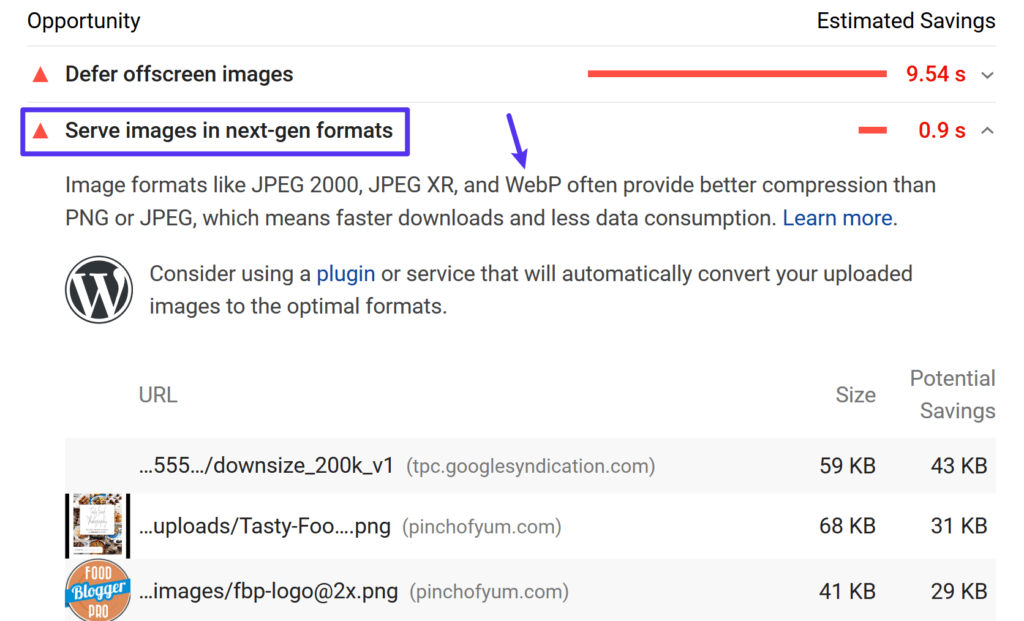
That'due south the reason why if y'all run your site through PageSpeed Insights, i of the many recommendations is to Serve images in adjacent-gen formats like WebP:
So how does Google's WebP format attain these reductions in file size?
Showtime, it supports lossy and lossless compression, then the exact reduction volition depend on whether you're using lossy or lossless compression.
With lossy compression, WebP uses something called "predictive coding" to lower the file size. Predictive coding uses the values of neighboring pixels in an prototype to predict values and so simply encodes the deviation. It'south based on VP8 cardinal frame encoding.
Lossless WebP uses a much more complicated set of methods that were developed by the WebP team.
If you want to learn well-nigh the WebP compression techniques in particular, this commodity is a skilful starting point.
Which Web Browsers Support WebP?
For WebP images to work, a company's spider web browser needs to back up them. Unfortunately, while browser support has grown a lot, WebP compatibility is still non universal.
WebP images are supported by popular browsers such as:
- Chrome (desktop and mobile)
- Firefox (desktop and mobile)
- Microsoft Edge
- iOS and macOS Safari (macOS xi Big Sur and later only)
- Opera (desktop and mobile)
At the fourth dimension that nosotros're writing this mail, Safari supports WebP images only partially.
Internet Explorer likewise lacks WebP support (but Edge supports WebP as it'south based on Chromium). Notwithstanding, IE usage has shrunk to less than i% of total internet users. That's a benefaction for everyone on the web!
In total, around 95% of Internet users use a browser that supports WebP. So while it certainly has bulk support, that 5% is a minor hurdle, especially when it's Safari users on older macOS versions. In our WordPress WebP tutorial below, we'll evidence you how to handle this so that all of your visitors have a great experience.

WebP vs JPG vs PNG Size Comparison
Co-ordinate to Google's tests, WebP images are:
- 25-34% smaller than comparable JPEG images.
- 26% smaller than similar PNG images.
If you desire to learn more about Google's methodology, you can find direct links to the full results below:
- JPEG
- PNG
Both tests are based on over 11,000 images, including:
- The famous Lenna image
- 24 images from Kodak truthful color epitome suite
- 100 images from Tecnick.com
- A random sample of 11,000+ images from Google Image Search
How to Employ WebP Images on WordPress
Starting with WordPress five.8, you'll be able to use the WebP image format the same way as JPEG, PNG, and GIF formats. Just upload your images to your Media Library and include them in your content. As WordPress 5.8+ supports the WebP format by default, you don't take to install third-political party plugins to upload WebP images. That should suffice for most common use cases.
To get started immediately, you can refer to our quick primer on using WebP images in WordPress 5.8+. We suggest y'all become through the caveats about WebP support in WordPress.
Nonetheless, around five% of people (mainly Safari users on older macOS) use a web browser that doesn't support WebP. If you catechumen WebP images and employ them directly in your content, those visitors wouldn't be able to see your images, which would ruin their browsing experience.
Too, generating WebP images isn't as straightforward every bit getting a JPG/JPEG prototype, which is the default prototype file format on nearly cameras, smartphones, and online image libraries. WordPress doesn't support automated image conversion to WebP format (nevertheless!).
Don't fret! There'due south a solution.
You can use a WordPress plugin that converts your original images to the WebP format and likewise provides the original paradigm as a fallback if a visitor's browser doesn't support WebP.
For example, if you upload a JPEG file to your site, the plugin volition:
- Catechumen the JPEG file to WebP and serve the WebP version for Chrome, Firefox, Border, etc.
- Show the original JPEG file to visitors browsing with Safari (on older macOS versions) and other browsers that don't back up WebP.
That manner, everyone can encounter your image, and everyone gets the fastest experience possible.
Below, we'll become through some of the all-time WebP WordPress plugins, all of which work with Kinsta and the Kinsta CDN.
ShortPixel

ShortPixel is a pop WordPress image optimization plugin that can help you automatically resize and compress the images you upload to your WordPress site.
Subscribe Now
Equally part of its feature listing, ShortPixel can also help you automatically convert images to WebP and serve those images to browsers that support it.
ShortPixel has a express free plan that lets you optimize ~100 images per month for free. Paid plans commencement at $four.99 per month for up to 5,000 images/credits or $nine.99 1-time for a pack of ten,000 credits.
ShortPixel counts each WordPress prototype size that you optimize equally a credit. So if you desire to optimize multiple image thumbnail sizes, one prototype could feasibly apply numerous credits. There are no file size limits for images.
You can spread your ShortPixel credits over unlimited websites – in that location are no per-site limits (and all your websites can use the same ShortPixel account).
To use ShortPixel to serve WebP images on WordPress, yous'll need to install the plugin from WordPress.org and add your API central (which you can get by registering for a gratis ShortPixel account).
In the General tab, y'all can gear up up basic settings for how image optimization works. For example, what compression level to use and whether or not to resize images:

To enable WebP images, get to the Advanced tab and:
- Bank check the box for WebP Images
- Bank check the box to Deliver the WebP versions… (this appears after yous bank check the commencement box)
- Select the radio button for Using the <PICTURE> tag syntax (this appears after checking the previous box)
- Exit the default Only via WordPress hooks selection
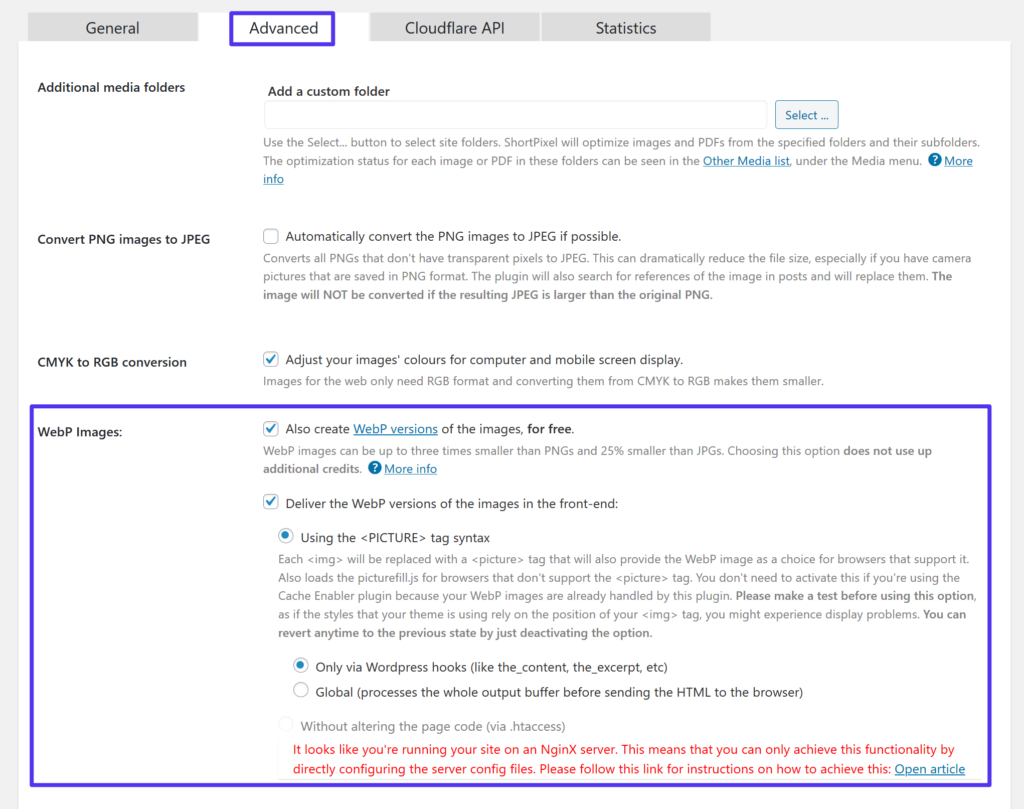
And so, save your changes.
If you're hosting at Kinsta, ShortPixel volition give you lot a warning message about configuring server config files on Nginx. To configure these settings, you can reach out to Kinsta support, and we'll be happy to set the server configuration for y'all.
Imagify

Imagify is a pop image optimization plugin from the same developer equally WP Rocket (one of the few caching plugins that work with Kinsta).
Information technology can automatically compress and resize the images that you upload to your WordPress site. Then, information technology can as well help you catechumen them to WebP and serve those versions to visitors with browsers that back up information technology.
In terms of features, ShortPixel and Imagify share a lot of similarities. The most meaning difference comes when y'all expect at pricing. Whereas ShortPixel charges y'all based on images with no size limit per epitome, Imagify charges you based on overall file size, with no image limit.
And so if you need to optimize lots of large images, ShortPixel'southward arroyo might exist cheaper. Simply if you need to optimize lots of modest images, Imagify's arroyo might be more affordable.
Imagify has a limited complimentary tier that allows for 25 MB of optimizations per calendar month. After that, paid plans start at $4.99 per month for up to 1 GB or $9.99 for a quondam credit of ane GB.
Similar ShortPixel, yous can spread your account limits over unlimited websites.
To use Imagify to deliver WordPress WebP images, you lot'll need to install the plugin from WordPress.org and add your API key to get started.
Once you've activated the plugin, you can use the General Settings box to choose your compression level.

To enable WebP images, scroll down to the Optimization section and detect the WebP Format department:
- Check the box to Create webp versions of images
- Check the box to Display images in webp format…
- Select the radio push to use <picture> tags

As with ShortPixel, if you're hosting at Kinsta, you lot'd need to create an Nginx rule for WebP enshroud buckets (achieve out to Kinsta support).
Optimole

Optimole is a WordPress image optimization plugin that operates a little differently than Imagify and ShortPixel. Optimole tin can automatically compress and resize your images. Even so, it likewise has 2 other notable features:
- It tin can serve your images via its CDN (powered by Amazon CloudFront).
- It offers real-time adaptive images whereby Optimole will evangelize the optimally sized epitome for each visitor. For case, someone browsing on a pocket-size screen will go a lower-resolution paradigm than someone browsing on a Retina screen.
This approach is similar to other real-time optimization/manipulation services like Cloudinary, imgix, KeyCDN Prototype Processing, etc.
Optimole can likewise evangelize WebP images to visitors with browsers that support information technology as part of this real-fourth dimension epitome optimization.
Optimole has a limited gratuitous programme that tin handle serving images to around ~5,000 visitors per month. After that, paid plans start at $19 per month for ~25,000 visitors.
To become started, you'll need to install the plugin from WordPress.org and actuate it with an API key (which you can go by registering for a free Optimole business relationship).
Once yous do that, Optimole volition beginning automatically optimizing your images and delivering them via its CDN. WebP support is on by default, and then at that place's no need to enable it manually.
To configure other settings, like compression levels and scaling beliefs, you lot tin can go to Media → Optimole → Settings:

Since Optimole handles delivering your images via its CDN, there's no need to ready upwardly any Nginx rules if you're hosting at Kinsta.
Summary
Your WordPress site's images make up a big part of the file size of an boilerplate page. If you can find ways to reduce the size of your images, y'all can speed upward your site without hurting the user feel. WebP is a modern epitome format that does exactly that by offering a ~25% reduction in file size vs comparative JPEG or PNG files.
Around 95% of Net users already utilize a browser that supports WebP. WordPress 5.viii+ versions also support WebP out of the box at present. And so there's no reason y'all shouldn't employ it.
However, a minority of browsers, notably Safari on older macOS versions, all the same don't offer WebP support. Hence, yous cannot serve WebP images to all visitors yet. To address this issue, y'all can apply a WordPress plugin that converts images to WebP and serves WebP versions to visitors whose browsers support it while using the original images to visitors whose browsers don't.
For more than tactics to optimize images, check out our full guide to optimize images for web performance.
If you have any questions well-nigh using WebP on WordPress, please inquire us in the comments below!
Save time, costs and maximize site performance with:
- Instant help from WordPress hosting experts, 24/seven.
- Cloudflare Enterprise integration.
- Global audition reach with 29 data centers worldwide.
- Optimization with our born Awarding Performance Monitoring.
All of that and much more, in one programme with no long-term contracts, assisted migrations, and a 30-mean solar day-coin-back-guarantee. Bank check out our plans or talk to sales to find the programme that's right for you.
Source: https://kinsta.com/blog/webp/
0 Response to "How to Upload Webp Images to Wordpress"
Post a Comment